What began as the recovery of a single World War II-era bomb in Jharkhand’s Baharagora has now escalated into a wider security concern, with early indications suggesting the possibility of a cluster of unexploded ordnance beneath the area.
Days after a 500-pound American aerial bomb was recovered from the Subarnarekha riverbank on 17 March, a subsequent drone survey by the Indian Army has detected another similar object in the vicinity. Local accounts have further raised the possibility of several more devices buried across the sandy stretch.
Advertisement
With the threat assessment intensifying, the Army has assumed operational control of the site, deploying its Bomb Disposal Squad, along with specialised detection systems and aerial surveillance, to systematically map the terrain. The zone is now under close and continuous monitoring.
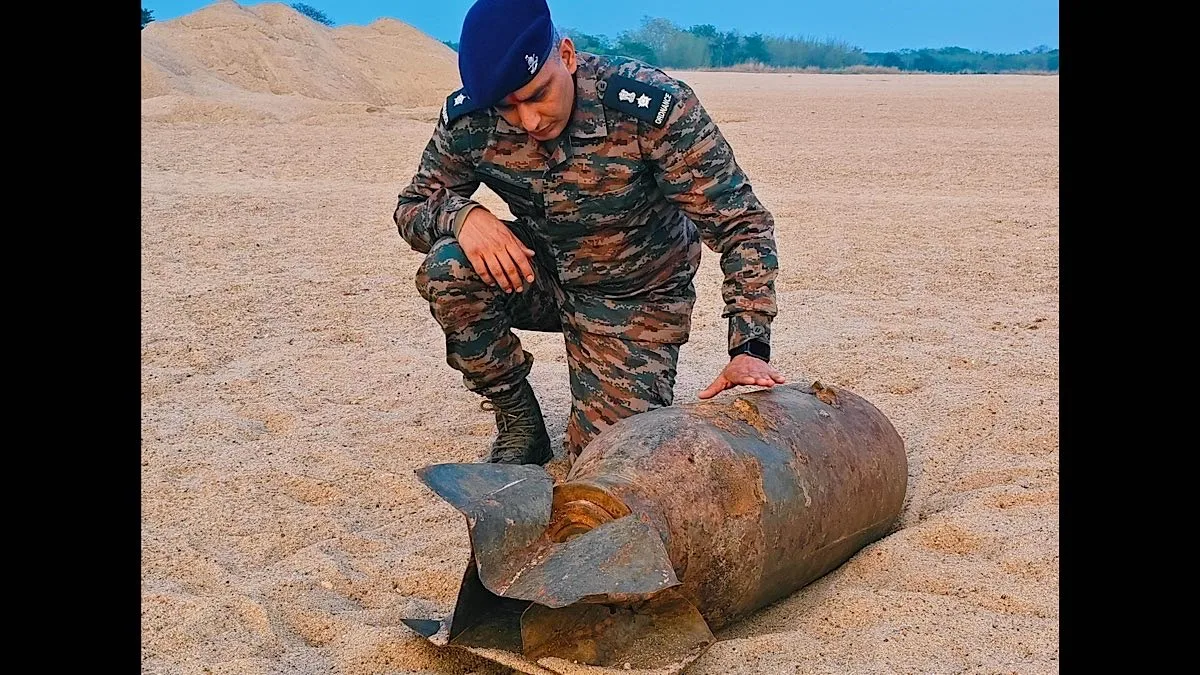
Crucially, the Army has brought in ammunition expert Lt Col Dharmendra Singh, who has nearly 20 years of experience in bomb disposal operations. On 24 March, he carried out an on-site inspection of the World War II-era bomb, conducting a detailed technical assessment of its depth, condition and stability. Based on this evaluation, officials confirmed that a controlled disposal operation is scheduled for the morning of 25 March.
The recovered munition has been identified as an AN-M64 500 lb American aerial bomb. Defence experts caution that such ordnance, even after decades underground, can remain highly unstable and retain considerable explosive force, requiring extreme precision in handling and disposal.
As a precautionary measure, a two-kilometre radius around the site has been declared a restricted zone. Civil authorities have sealed access, while joint teams continue systematic sweeps using metal detectors to locate any additional devices.
The developments have also drawn attention to the initial handling of the first discovery, which reportedly remained unsecured for several days. However, since the Army’s intervention, standard operating procedures are being enforced with greater rigour.
Experts note that the presence of multiple devices, combined with local claims of further buried ordnance, raises the possibility that the Subarnarekha belt could constitute an unexploded ordnance pocket linked to wartime activity.
For now, officials maintain that the situation is under control. The outcome of the scheduled disposal operation is expected to be critical in determining the scale of the threat that may still lie beneath the surface.